

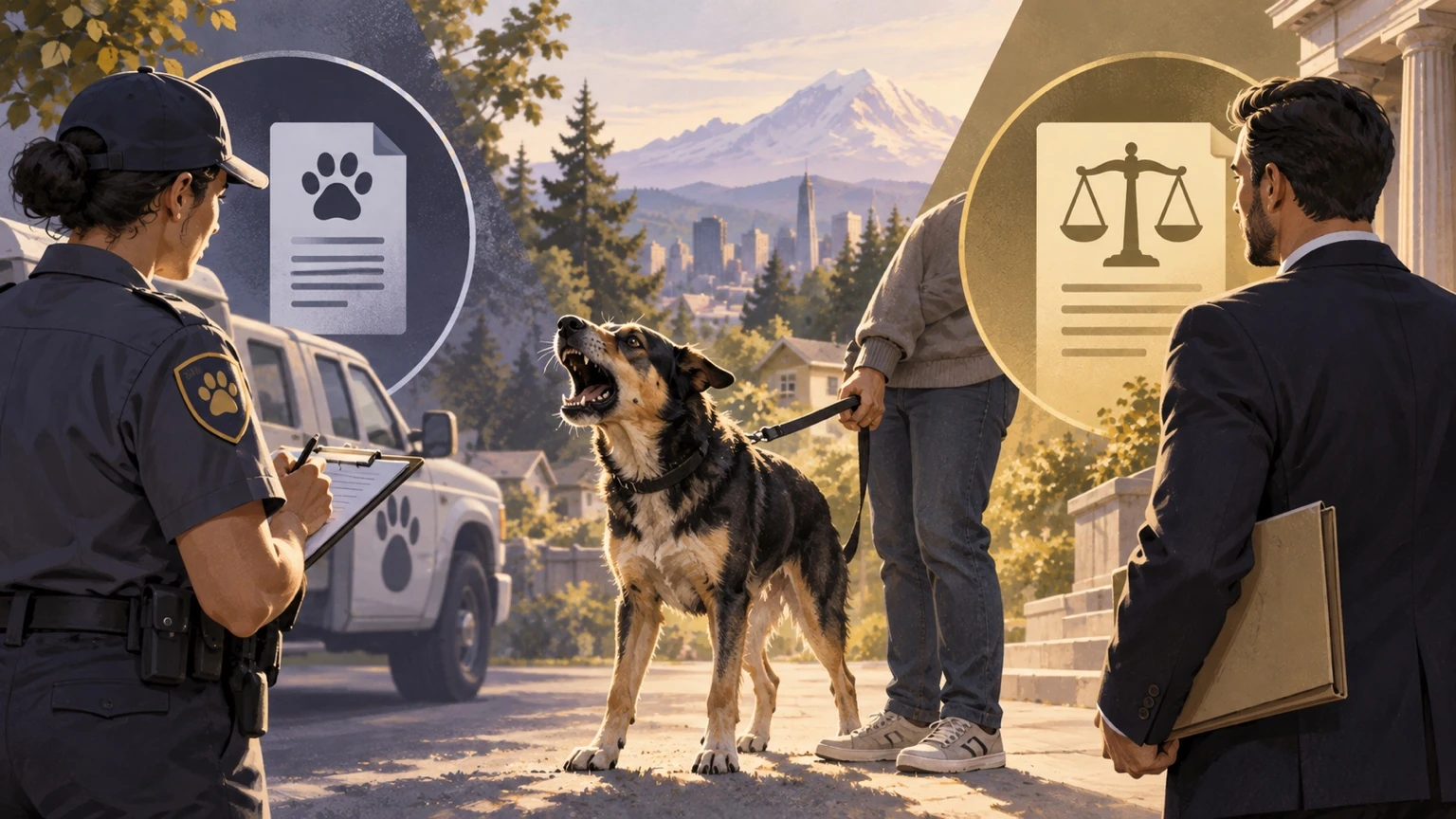
A common way for a real claim to die is for the injured person to abandon it after a phone call. Animal control looked into it, nothing happened to the owner, and that felt like a verdict.
It was not a verdict. It was a different system reaching a decision about a different question.
Two systems, two questions
Animal control enforcement asks whether an ordinance was violated and what should happen to the dog. The decision-maker is an agency, the standards come from local code, and the possible outcomes are things like a citation, a quarantine, a containment requirement, or a dangerous-dog declaration. Agencies also exercise discretion, weighing evidence, resources and jurisdiction like any other enforcement body.
A civil injury claim asks whether the dog's owner owes you damages and how much. The decision-maker is a court, the standard comes from state statute, and the outcome is money.
Neither controls the other. They can come out differently on the same afternoon.
What RCW 16.08.040 actually requires
Under RCW 16.08.040, the owner of a dog that bites a person is liable for the damages suffered, when the bitten person was in a public place or lawfully on private property, including the owner's own property. The statute applies regardless of the dog's former viciousness or the owner's knowledge of that viciousness. It carries an exception for the lawful application of a police dog.
That is the test. A bite, by a dog, whose owner you can identify, to a person who was lawfully where they were.
What the statute does not require
- A citation, ticket or infraction.
- A warning to the owner.
- A potentially dangerous or dangerous dog declaration.
- A prior bite, or any prior complaint.
- Proof that the owner knew the dog might bite.
- An animal control investigation at all.
None of those are elements. Their absence proves nothing about the claim.
There is structural evidence for this in the statute book itself. Chapter 16.08 RCW handles bite liability in one place and the dangerous-dog framework in a separate group of sections with their own definitions, notice requirements and consequences. The legislature built two different mechanisms. Treating one as a precondition for the other collapses a distinction that the code deliberately draws.
What still has to be right
None of the above means every bite produces a recovery, and it would be dishonest to suggest otherwise. Three things genuinely matter:
Ownership. The statute reaches the dog's owner. Washington courts have held that "owner" in this statute excludes people who are merely keepers or possessors, so identifying who actually owned the dog can matter, particularly where a walker, sitter or facility was holding it.
Where you were. Lawful presence on private property is defined by RCW 16.08.050, and consent is not presumed on property that is fenced or reasonably posted.
Provocation. It is a complete defense under RCW 16.08.060, not a reduction in damages.
And the statute covers bites. A knockdown, a collision or a fall without a bite is a negligence claim instead, where what the owner knew and did becomes directly relevant in a way it is not here.
When animal-control history does help
Not as an element, but as evidence and as leverage.
Depending on the agency and the incident, a file may contain the officer's factual findings, witness statements, quarantine documentation, the owner's own early account, and sometimes prior complaints at the same address. Sometimes it contains none of that. Agencies differ, records differ, and it is a mistake to assume a prior history exists before anyone has looked.
Whether any particular part of a file would be admitted at trial is a separate question decided under the rules of evidence. The reliable value is earlier: it fixes the owner's identity, it documents the incident close in time, and it is hard for an adjuster to argue around a contemporaneous government record.
What a closed complaint actually means
Usually less than it sounds like. A file can close because the owner complied with what was asked, because the agency could not reach a witness, because the incident fell outside its jurisdiction, or because the officer concluded the local code was not violated even though someone was hurt.
An agency deciding not to cite is not an agency deciding the owner did nothing wrong. It is an agency deciding what enforcement action, if any, its code supports.
Get the record instead of guessing
If you do not know what the agency found, the answer is available rather than inferable. Washington's Public Records Act allows anyone to request identifiable public records, and RCW 42.56.080 is explicit that a request for all records on a particular topic, or containing a particular keyword or name, is a valid request. You do not have to know the document's name, and you do not have to explain why you want it.
Ask in writing, give the date, the location and any incident number, and ask sooner rather than later.
The office reviews Washington dog-bite claims at no cost, and there is no fee unless the claim resolves in your favor.