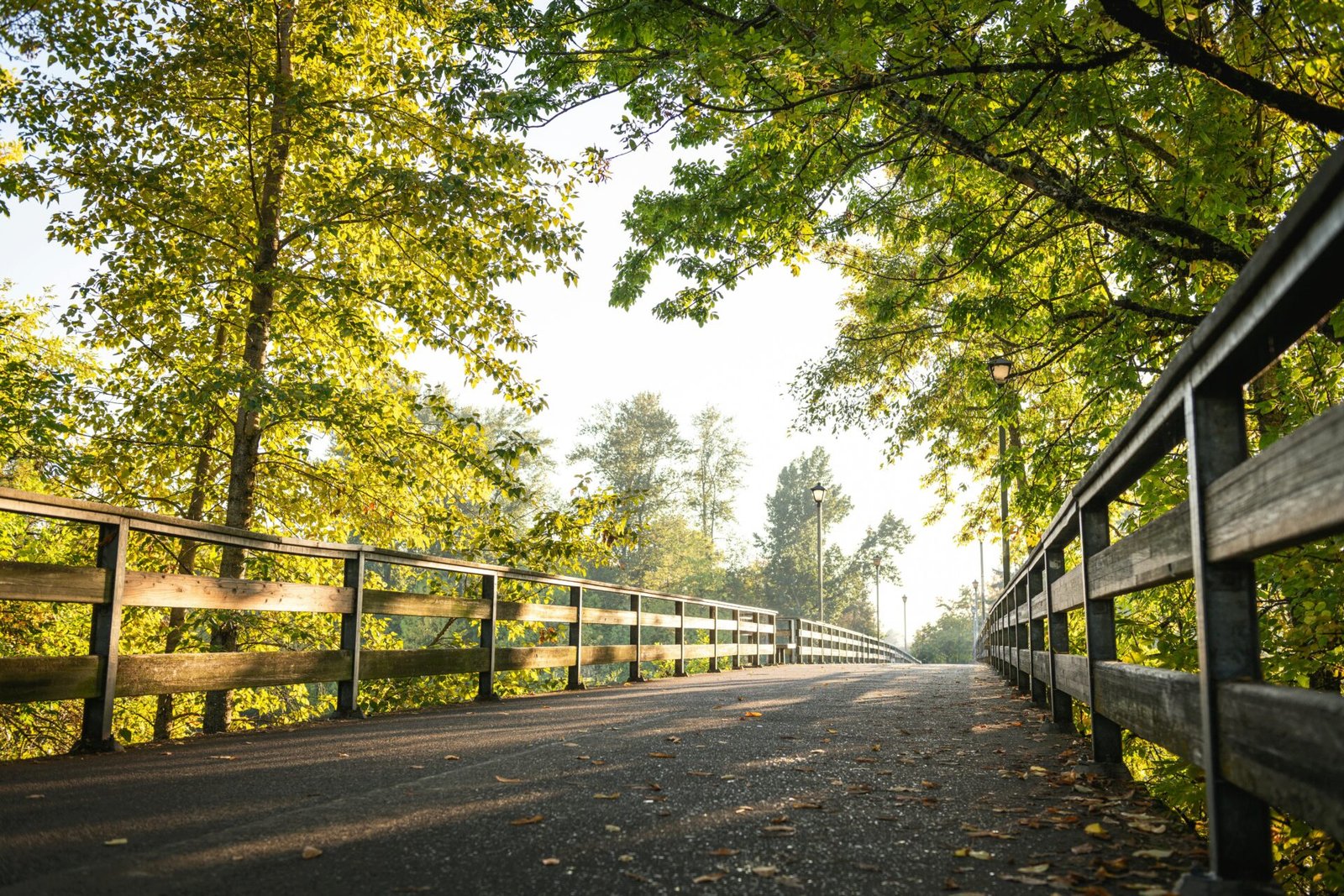
Seattle’s trail system is one of the most-used urban recreational networks in the Pacific Northwest. On any given afternoon, the Burke-Gilman and Sammamish River Trails carry a mix of commuter cyclists, recreational runners, families with strollers, and — frequently — off-leash dogs.
Most of the time, this coexistence works. But the combination of high speeds, close quarters, and poorly controlled dogs creates real conditions for serious injury. A dog that bolts across the trail path, charges a cyclist, or bites a runner can cause fractures, road rash, dislocations, and significant soft-tissue damage — even when no actual bite occurs.
If you were injured by a dog on a King County trail, the legal framework that applies to your situation depends on a few key facts: whether the dog bit you, whether it was leashed, and exactly where on the trail the incident happened.
The Bite vs. Non-Bite Distinction on Trails
Washington’s strict liability statute — RCW 16.08.040 — applies to actual bites. If a dog bit you on the Burke-Gilman or Sammamish River Trail, the owner is strictly liable for your damages, provided you were lawfully using a public path. That is a clean, straightforward claim.
Many trail injuries, however, do not involve a bite. A dog that darts across the path and causes a cyclist to crash, a dog that charges a runner and causes them to fall, or a dog that jumps on a pedestrian and knocks them down — these are all serious injuries, and none of them trigger the strict liability statute.
Those claims proceed under common-law negligence. And that is where Washington’s local trail ordinances become critically important.
Seattle and King County Leash Laws on Public Trails
Both Seattle and King County have clear, enforceable leash requirements for dogs in public spaces.
Seattle Municipal Code SMC 9.25.084 requires that dogs in public areas be kept on a leash no longer than eight feet. King County Code KCC 11.04.230 imposes the same requirement throughout the county’s public spaces.
The Burke-Gilman Trail runs through Seattle and portions of unincorporated King County. The Sammamish River Trail passes through Redmond and other incorporated areas of the county. Both fall within jurisdictions that mandate leash compliance on shared public paths.
When an owner allows a dog to roam off-leash on a public trail in violation of these ordinances, and that dog injures someone, the ordinance violation establishes negligence per se. In practical terms, this means the court treats the leash law violation as automatic proof of negligence — the plaintiff does not need to establish a separate, detailed analysis of whether the owner behaved unreasonably. The violation itself answers that question.
How Negligence Per Se Works in a Trail Case
Negligence per se is particularly useful in trail dog attack cases because it simplifies what can otherwise be a contested liability question.
Without negligence per se, a plaintiff must typically prove: (1) the defendant owed them a duty of care, (2) the defendant breached that duty by failing to act as a reasonable person would, (3) the breach caused the injury, and (4) real damages resulted.
With negligence per se based on a leash ordinance violation, elements one and two are largely resolved by the ordinance itself. An owner who lets a dog run loose on a public Seattle or King County trail has, by definition, violated a law specifically designed to protect the public from exactly that kind of harm.
Documenting the leash law violation — whether through your own observation, witness accounts, or photographs taken immediately after the incident — becomes an important part of building the claim.
The Challenge of High-Speed Trail Incidents
Bicycle crashes caused by dogs present particular documentation challenges. The incident often happens quickly, the cyclist is focused on avoiding injury rather than preserving evidence, and there may not be witnesses nearby.
Steps that help preserve a trail injury claim:
Report to animal control immediately. Both Seattle Animal Shelter and King County Animal Care and Control accept trail-related dog incident reports. This creates an official record and may surface prior complaints about the same dog or owner.
Get contact information for the owner. If the owner is present and cooperative, their name and phone number are essential. If they left the scene, report that as well — animal control can sometimes identify dogs through microchip registries and local license records.
Photograph the scene. If you are physically able, document: the location on the trail, any injuries visible, any items damaged in a crash (bicycle, helmet), and the surrounding area.
Find witnesses. Trails are busy places. Other cyclists, runners, and walkers often see what happened and may be willing to provide statements or contact information.
Seek medical treatment the same day. A physician’s documentation of your injuries, taken close to the time of the incident, is stronger evidence than records created days later.
What Damages Might Be Available
The range of compensable damages in a trail dog attack case depends on the injury. Common categories include:
Medical costs: Emergency treatment, imaging, surgery, physical therapy, and follow-up care. For cyclists who go down at speed, injuries can include fractured clavicles, wrist fractures, road rash requiring debridement, and shoulder separations — all of which involve real ongoing medical costs.
Lost wages: Time missed from work during recovery is compensable as economic damage. For a cyclist who commutes to work and is unable to do so during recovery, or a runner who cannot perform physical job duties, wage documentation matters.
Property damage: A damaged bicycle is property damage recoverable in addition to personal injury claims. Helmets destroyed in a crash, electronics damaged in a fall — these are calculable losses.
Non-economic damages: Pain, suffering, disruption to regular physical activity, and psychological effects of the incident. For serious cyclists who are sidelined from a central part of their daily life and fitness routine, this component of the claim can be meaningful.
Off-Leash Parks on Trail Corridors
Some sections of the Burke-Gilman and Sammamish River Trail corridors pass near designated off-leash areas. This occasionally creates confusion about where leash requirements begin and end.
The answer is clear: a designated off-leash zone suspends the leash requirement within its boundaries. The moment a dog and owner are on the shared trail itself — not within the designated off-leash enclosure — the leash law applies again.
A bite that occurs on the trail, regardless of proximity to an off-leash area, is subject to the full strict liability analysis. A non-bite injury that occurs on the trail from an off-leash dog is subject to the negligence per se analysis based on the ordinance violation.
If You Were Injured on a Seattle or King County Trail
The Law Office of J.D. Smith handles dog attack cases arising from trail incidents throughout King County, including on the Burke-Gilman and Sammamish River Trails. These cases have specific evidentiary dynamics — documentation timing is critical, and the distinction between bite and non-bite injuries affects which legal framework applies.
If you were hurt on a trail, contact us to talk through the details of what happened. Initial consultations are free.
Frequently Asked Questions
If I was cycling when the dog attacked me, does it matter that there was no bite?
Non-bite trail injuries proceed under negligence rather than strict liability. If the dog was off-leash in violation of Seattle or King County ordinances, that violation establishes negligence per se — a streamlined route to proving liability without needing to argue the owner behaved unreasonably.
What if the dog’s owner ran away after the incident?
A hit-and-run dog attack creates ownership identification challenges but does not end the claim. Report to animal control immediately. Officers can canvass the area, check license registries, and investigate. Witnesses, trail cameras, and nearby doorbell systems can also help identify the owner.
Can I recover for a damaged bicycle in addition to my injuries?
Yes. Property damage is a separate, recoverable component of the claim. A detailed repair estimate or replacement value for damaged equipment should be documented as part of the overall damages picture.
Are trails in Redmond and Kirkland covered by the same leash laws?
Redmond, Kirkland, and other King County municipalities have their own codes, but King County Code KCC 11.04.230 provides a countywide baseline for unincorporated areas. Most incorporated cities have parallel or more restrictive ordinances. The leash law negligence per se framework applies throughout the relevant trail corridors.
What if I was also partially at fault — for example, cycling too fast?
Washington follows a pure comparative fault system for negligence claims. A finding that you were partially at fault reduces your recovery proportionally but does not eliminate it. Someone found 25 percent at fault still recovers 75 percent of their damages.